
Asked to choose between epoxy and polyaspartic, most people expect one of them to win. On a professionally installed floor the honest answer is usually that both are involved, doing different jobs.
That sounds like a dodge until you look at how these floors are actually built. A finished coating is not one product spread on concrete. It is a sequence of layers, each chosen for what it has to do, and the chemistry that works best at the bottom is often not the chemistry that works best on top.
Once you see a floor that way, the question changes from which chemistry is better to which chemistry belongs in which layer, and that is a question a contractor can actually answer about your slab.
A Floor Is a System, Not One Product
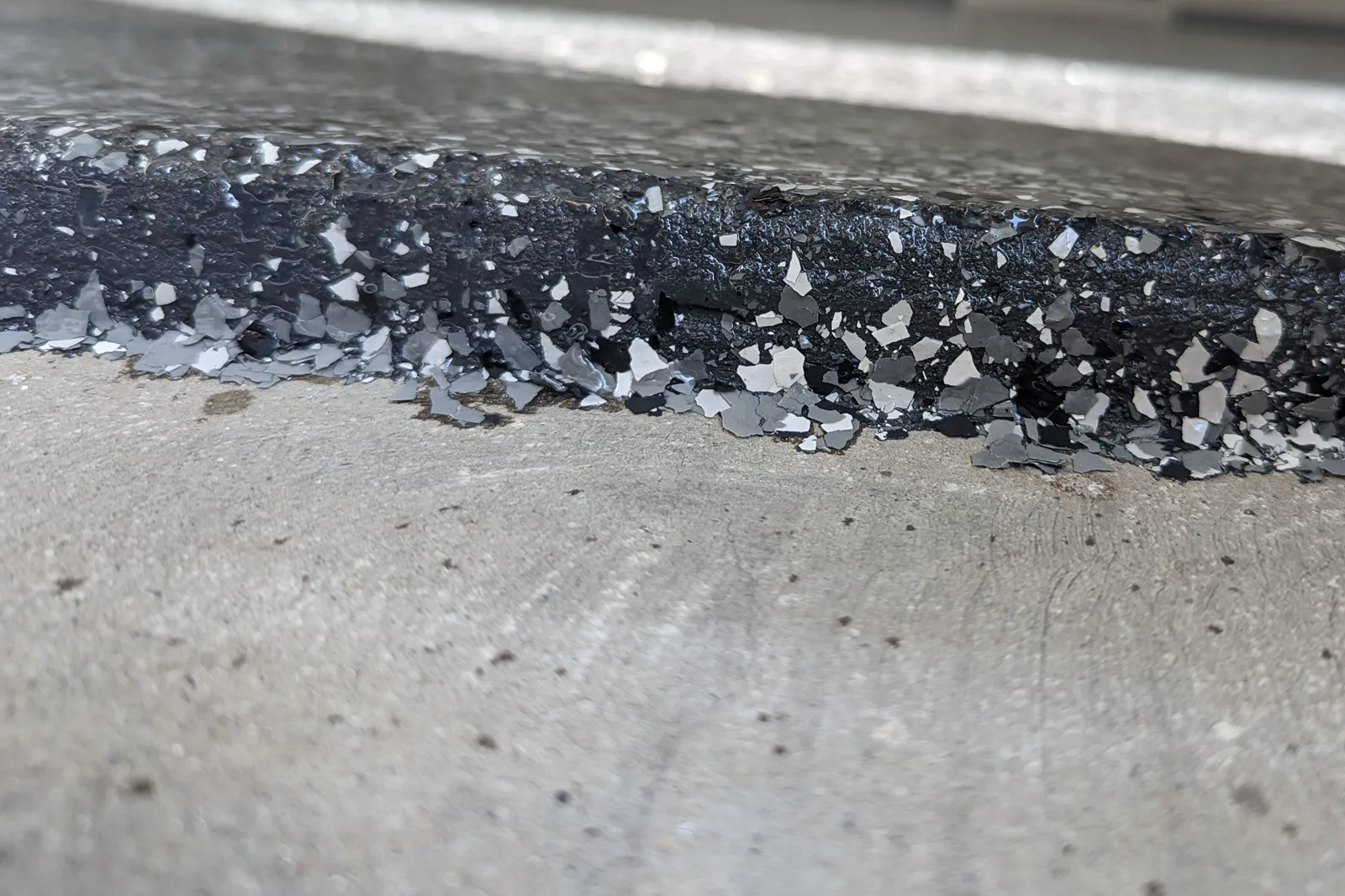
The photograph above is the clearest evidence of the point. At the edge, where the coating stops, you can see that the floor has a structure: something bonded to the concrete, a decorative layer held in resin, and a clear surface over the top of it.
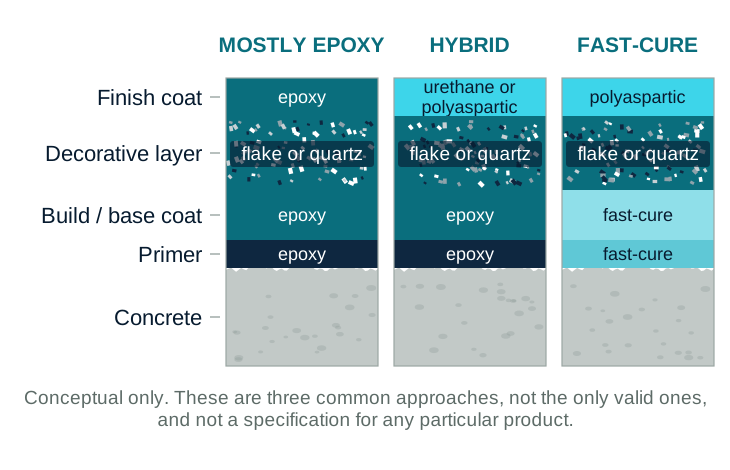
Most professional systems separate the work into roughly four roles:
- A primer that bonds to the prepared concrete and prepares the surface for what follows
- A build or base coat that provides thickness, color, and body
- A decorative layer, where flake, quartz, or metallic pigment goes
- A finish coat that becomes the wearing surface and takes the exposure
Each role has different demands. The primer has to bond and penetrate. The build coat has to be thick, workable, and level. The finish coat has to resist traffic, cleaning, and sunlight. There is no rule that says one chemistry must fill all four.
The decorative layer is its own decision. Decorative flake systems fill that role with broadcast media, and the choice affects texture and appearance more than it affects the chemistry underneath.
What Epoxy Contributes
Epoxy is a two-part resin system that has been used on concrete for decades, and its strengths tend to show up in the layers underneath.
It bonds well to properly prepared concrete. It is available in high-build and self-leveling formulations, which matters when a slab needs thickness or correction rather than just color. It generally offers a longer working time than fast-curing alternatives, which gives a crew more room to spread material evenly and fix problems before it sets. It comes in a wide range of formulations, including the heavy-build and chemical-resistant systems used in industrial settings.
The trade-offs are the other side of the same characteristics. Epoxy usually cures more slowly, which lengthens the project. Conventional formulations can amber or discolor with prolonged ultraviolet exposure, which matters where sunlight reaches the floor. Cold temperatures slow it further.
None of this makes epoxy a lower-grade material. It makes it well suited to the parts of the system that need adhesion, build, and working time, and less suited to being the exposed surface in a sunlit space.
What Polyaspartic Contributes
Polyaspartic is a faster-curing resin technology, and its strengths tend to show up at the top of the system.
Products designed for exterior exposure are commonly formulated for ultraviolet stability, which is the single most useful property a finish coat can have where daylight reaches the floor. Clear formulations work well over decorative flake and quartz, sealing the media without obscuring it. Polyaspartic systems are frequently selected where a faster return to service matters, which is why they appear so often in garages, retail areas, and spaces that cannot stay closed.
The trade-offs are real too. Material cost is often higher. The working time is short, which leaves an installer far less room to correct roller marks, uneven coverage, or a missed area, and makes crew experience more important rather than less. Cure behavior shifts with temperature and humidity. The polyaspartic flooring guide covers how the material tends to appear in a quote and what to confirm alongside it.
Hybrid Systems Are Common, Not a Compromise
Put the two sets of strengths side by side and a common professional answer becomes obvious: use epoxy for adhesion and build, and use a UV-stable polyaspartic or urethane as the finish coat.
That is not a workaround. It is a designed system, and manufacturers publish builds that work exactly this way. Sherwin-Williams describes its Resuflor Topcoat Metallic II system as a high-solids epoxy applied as primer and pigmented base coat, followed by a semi-transparent metallic coat, and finished with a UV light-stable satin urethane topcoat. That is one manufacturer's published sequence for one named system rather than a description of every metallic or hybrid floor, but it illustrates the principle plainly: epoxy underneath, a different chemistry on top, each doing what it does best.
This is why the question "is it epoxy or polyaspartic" often has no clean answer. A floor can legitimately be both. The useful question is which layer is which.
Comparing Them by Role
The table below describes tendencies rather than rules. Individual products vary, and a data sheet always outranks a generalization.
| Consideration | Epoxy tends to | Polyaspartic tends to |
|---|---|---|
| Usual role in a system | Primer, build coat, base coat | Finish coat, sometimes the full build |
| Where it sits | Beneath the decorative layer | Over the decorative layer |
| Working time on site | Longer and more forgiving | Shorter, with less room to correct |
| Return to service | Slower; the schedule comes from the product data | Often chosen where a faster return matters |
| UV stability | Varies by formulation; conventional epoxy can amber | Commonly formulated for exterior exposure |
| Build thickness | Strong high-build and self-leveling options | Commonly applied in thinner coats |
| Material cost | Often lower | Often higher |
Working Time Is Not the Same as Return to Service
These two get confused constantly, and they pull in opposite directions.
Working time is how long the crew has to place and level the material after mixing. A longer working time is easier to install well. A short one demands a coordinated crew moving quickly in sections.
Return to service is how long before you can walk on the floor, put things back, and park on it. A faster return is more convenient for you and reduces downtime for a business.
Fast-curing chemistry tends to shorten both at once, which is why polyaspartic is attractive on the schedule and demanding on the crew.
There are no universal numbers for either. Recoat windows, foot-traffic times, vehicle times, and full cure all depend on the specific products, the film thickness, the temperature, and the humidity on the day. The only schedule worth relying on is the written one supplied for the floor that was actually installed, which is one of the things a professional installation should hand over at completion.
UV Exposure and Why the Topcoat Matters Most
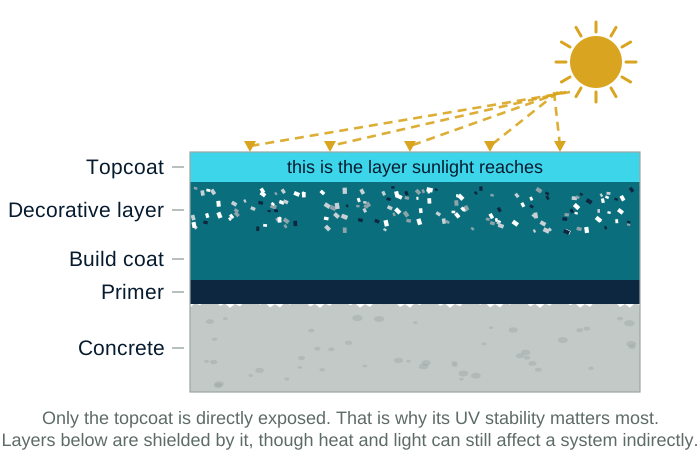
Sunlight only touches the top of the floor. Whatever is underneath is protected by the layer above it, which means UV stability is primarily a question about the finish coat rather than about the floor as a whole.
This matters wherever daylight reaches the surface: garages used with the door open, carports and covered walkways, entrances, and rooms with large windows or overhead doors.
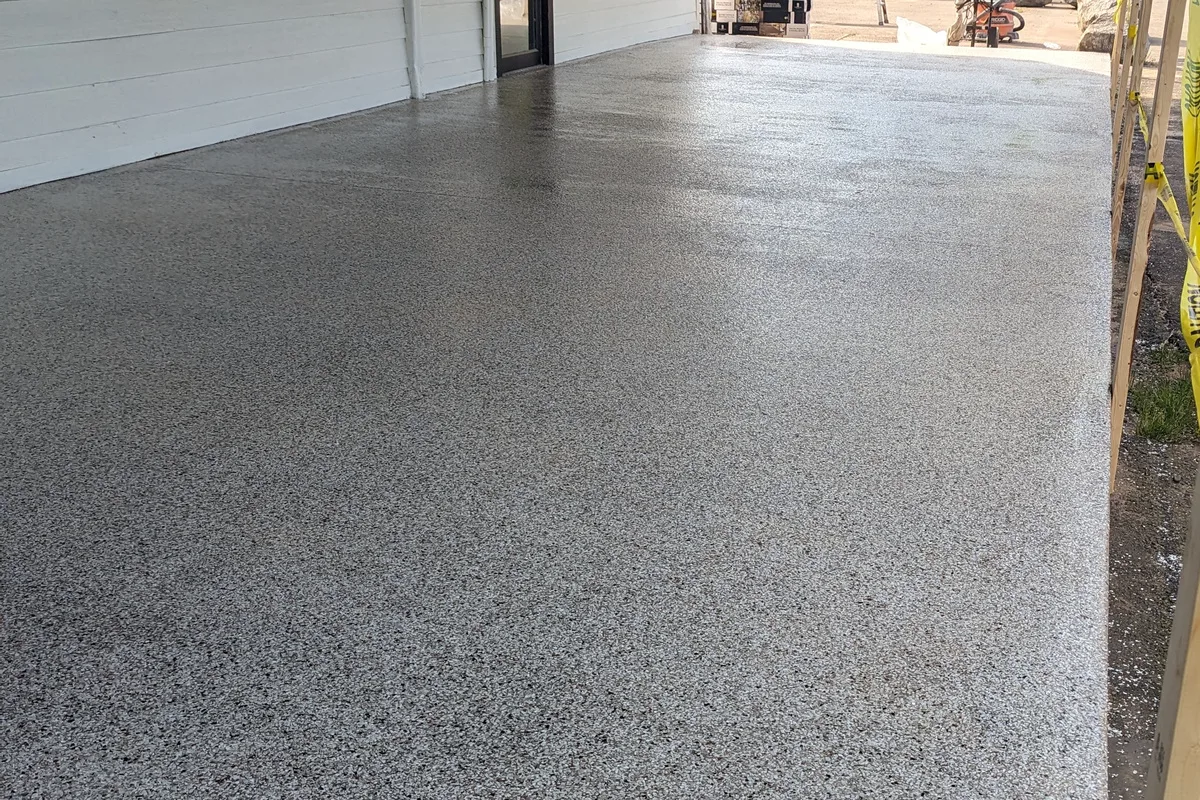
Manufacturers are explicit about this where it applies. The Sherwin-Williams color card for its Resuflor Topcoat Metallic range notes that certain colors will amber over time because of the inherent characteristics of the resin technology, and recommends looking at completed installations for an accurate impression. That note applies to specific colors in that manufacturer's range rather than to every metallic floor, but it is a useful reminder that ultraviolet behavior is a product-level question with a product-level answer.
The practical version is short: if daylight reaches your floor, ask specifically what the exposed layer is and whether it is approved for that exposure.
Durability Is a Property of the System
Asking which chemistry is more durable is a bit like asking whether steel or timber makes a stronger building. It depends entirely on how the thing is put together.
Service life comes from the combination of preparation, the bond to the concrete, the total build thickness, the finish coat, the traffic the floor sees, and how it is maintained. A well-designed epoxy system on a properly prepared slab will outlast a thin polyaspartic coating applied over a poorly prepared one, and the reverse is equally true.
The bond to the concrete is the part that decides most outcomes, and it is set by preparation rather than by chemistry. Neither material will last on oil, weak concrete, excess moisture, or an unprepared surface, which is the subject of the guide on why floor coatings come loose.
Scratch and Abrasion
No resinous floor is scratch-proof, and the honest position on abrasion is that it depends on the specific product and the finish rather than on the chemistry name.
A few things are worth understanding. Hardness and scratch resistance are not the same property, and a hard, high-gloss surface can show fine scratches more readily than a softer or more textured one simply because gloss reveals them. Texture, sheen, and slip-resistant additives all change how visible wear becomes. Dragged metal, grit tracked in on tires, and abrasive cleaning will mark either system.
If abrasion resistance genuinely matters for your use, the number to ask for is the manufacturer's published test result for the specific system, along with the test method it was measured by. That is a real answer. "It is harder" is not.
Garages
For a lot of residential garages, a decorative flake system with a UV-stable finish coat is a sensible default, because it handles daylight through an open door, tolerates vehicle traffic, and hides ordinary dirt better than a solid color.
That does not mean every layer should be the same chemistry. A common build uses a compatible primer, an epoxy or fast-cure base coat, a full flake broadcast, and a UV-stable clear finish. Whether the base is epoxy or fast-cure usually comes down to the slab, the weather, and how quickly you need the garage back.
Epoxy tends to be the better choice underneath when the slab needs real build thickness, when a metallic effect is wanted, or when a longer working time makes for a better installation.
Commercial and Industrial Floors
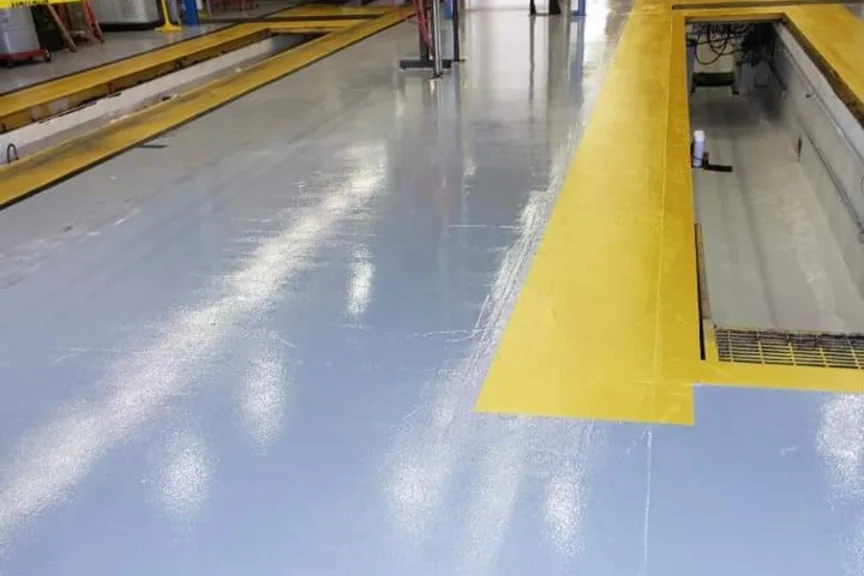
Here the environment should drive the decision rather than any preference between the two names.
Fast-cure systems are often preferred where a space cannot be closed for long: retail areas, corridors, service bays, and facilities that lose money while a floor is out of use. The value of reopening sooner can easily exceed the difference in material price. Choosing around those operating conditions is what the guide to commercial floor coatings works through.
Epoxy remains widely used where floors need heavy build, self-leveling, mortar systems, or specific chemical resistance, which covers a great deal of manufacturing, warehousing, and maintenance work.
For aggressive chemical exposure, thermal shock, food processing, or heavy impact, neither should be selected from a general comparison like this one. Those environments need a system selected against the actual exposure, with the manufacturer's chemical resistance data in hand.
What This Does to Cost
System choice affects price through several channels at once rather than through material price alone.
More layers mean more material, more labor, and more days on site. Fast-cure products usually cost more per unit but can compress the schedule. A thicker build uses more material. Decorative choices change both the media cost and the number of coats needed to seal them. And the preparation the slab requires is often the largest variable of all, regardless of which chemistry goes on afterwards.
That is why a quote for a coated garage floor is priced from the slab and the system together. The detail on what drives coating cost covers how these factors combine.
Questions to Ask a Contractor
These get you a far more useful answer than asking which chemistry is better:
- What is the complete system, layer by layer?
- Which of those layers are epoxy?
- Which layer is polyaspartic or polyurethane?
- What exact product is the exposed finish coat?
- Is that finish coat approved for the sunlight this floor will get?
- How will the concrete be prepared, stated as a method?
- What is the written return-to-service schedule for foot traffic, heavy items, and vehicles?
- What texture or slip resistance is included, and where?
- What maintenance does this system need, and what should not be used on it?
- What happens if the slab turns out to have moisture or contamination problems?
A contractor who can answer these clearly is describing a system. One who can only say the floor is epoxy is describing a category.
The Bottom Line
Epoxy and polyaspartic are not really competitors. They are materials with different strengths that frequently appear in the same floor, doing different jobs.
Epoxy earns its place in the layers that need adhesion, build, and working time. Fast-curing chemistry earns its place where sunlight reaches the surface or where the space has to reopen quickly. Plenty of good floors use both, and plenty of good floors use only one, depending on the slab and the conditions.
What separates a floor that lasts from one that does not is rarely the name of the resin. It is the preparation underneath, the suitability of the system to the space, and the care taken with each layer.