
Most people arrive at this question wanting one number. The honest answer is that a garage floor coating is priced from the slab, not from a rate card, and two garages of identical size can carry very different costs.
That is not a way of avoiding the question. It is the answer. The work that decides the price happens before any color goes down, and nobody can see all of it from a photograph or a phone call.
What this guide can do is explain exactly what moves the number, so that when quotes arrive you can tell whether you are comparing the same job.
Why this guide does not publish a price per square foot. Figures like that get copied between websites, age badly, and describe a system and slab condition that may have nothing to do with yours. A number that looks precise but does not apply to your garage is worse than no number at all. Ask for a written quote after an inspection, and use the sections below to check what is in it.
Why Square Footage Alone Does Not Decide the Price
Square footage sets the material quantity and little else.
A significant part of any project is close to fixed regardless of size: getting equipment to the site, setting it up, protecting the surrounding area, and cleaning up afterwards. Spread across a small floor, that fixed portion is a larger share of the total, which is why small garages usually cost more per square foot than large ones and why many contractors apply a minimum charge.
The variable part is driven by condition rather than area. A 400 square foot garage with a failing coating, oil contamination, and cracked slab sections can involve considerably more work than a 700 square foot garage with sound, bare concrete.
So the useful question is not what a coating costs per square foot. It is what has to happen to this particular slab before a coating can go on it.
The Condition of the Concrete
This is the single biggest variable, and it is the one a homeowner can partly assess before anyone visits.
Things that generally add work:
- An existing coating, paint, or sealer that has to come off
- Adhesive or backing left behind by carpet, tile, or sheet flooring
- Oil, transmission fluid, or other contamination that has soaked in
- Cracks, control joints in poor condition, spalls, and pop-outs
- Dusting or crumbling surface concrete
- Low spots or uneven areas that need to be brought level
- Previous patch repairs made with materials that may not be compatible
An estimate given before the floor is opened up is partly a prediction. Grinding is what reveals the real condition, and it regularly exposes problems that were invisible under dirt and old coating. This is normal and not a sign of anything untoward, but it does mean the proposal should say in advance how such discoveries will be handled.
Ask what triggers a change order, how it is priced, and whether you will be shown the problem before extra work starts. A contractor who has a clear answer has been here before.
Removal and Disposal
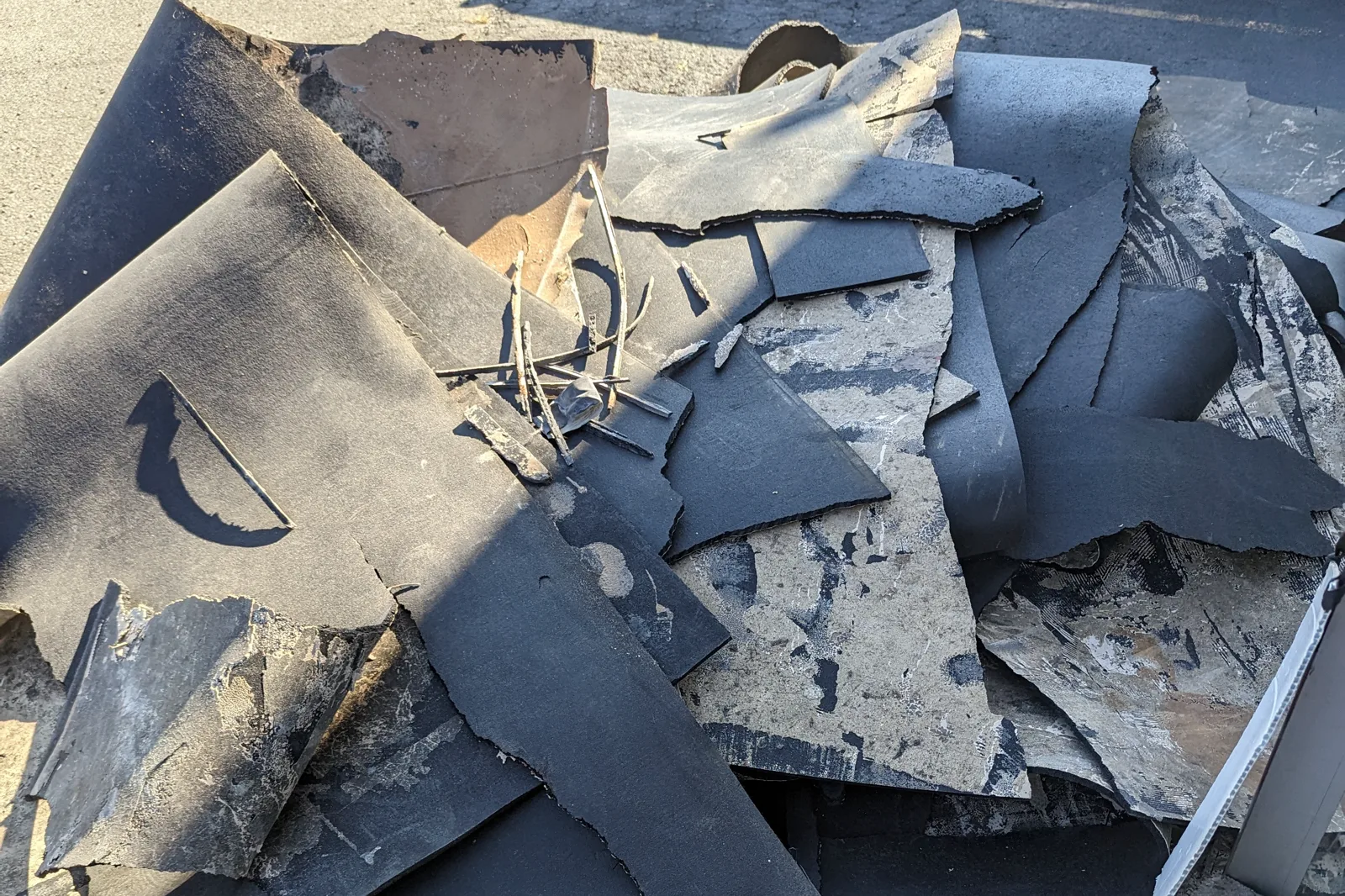
Removing what is already on the slab is its own line of work, and it is frequently underestimated by everyone involved.
The cost depends on what is there and how firmly it is attached. A thin, well-bonded sealer comes off quickly. Old adhesive, a thick coating, or a failed system that releases unevenly can take many times longer, wear through more consumable tooling, and produce a large volume of debris that has to be carried out, transported, and disposed of.
A garage that has been coated before is therefore not the same job as bare concrete, even if it looks tidier. If a previous floor came loose, it is worth understanding why coatings fail before the same slab is coated again, because the cause usually has to be dealt with rather than covered over.
Mechanical Preparation
On many garage projects this is the largest single labor item.
Professional preparation means grinding or shot blasting the slab to remove weak surface material and open the concrete so the coating can bond. It consumes machine time, power, dust extraction, and consumable tooling that wears down and gets replaced. Perimeters, corners, thresholds, steps, and the areas around fixed objects have to be done separately by hand, which is slow work that scales with the shape of the room rather than its area.
A garage with many corners, a stem wall to coat, or several doorways carries more of this hand work than a plain rectangle of the same size.
The awkward part is that preparation is invisible once the floor is finished. Two floors can look identical on handover day and behave completely differently a few years later, which is why the preparation method is worth having in writing rather than assumed.
Repairs, Joints, and Moisture
Repairs are priced by what the slab actually needs, and that is rarely known precisely in advance.
Cracks, spalls, pop-outs, and low areas are usually addressed with materials compatible with the coating going over them. Control joints need a decision rather than a default: some are filled, some are carried through to the finished surface, and the right choice depends on whether the joint is still moving.
Moisture is the factor most likely to change a quote significantly. Where there is reason to suspect moisture moving up through the slab, testing may be recommended, and if the results exceed what the chosen system allows, a moisture-mitigation product or a different system may be required. Not every garage needs this. Testing is what tells you, and it is far cheaper than discovering the problem after installation.
The System and How Many Layers
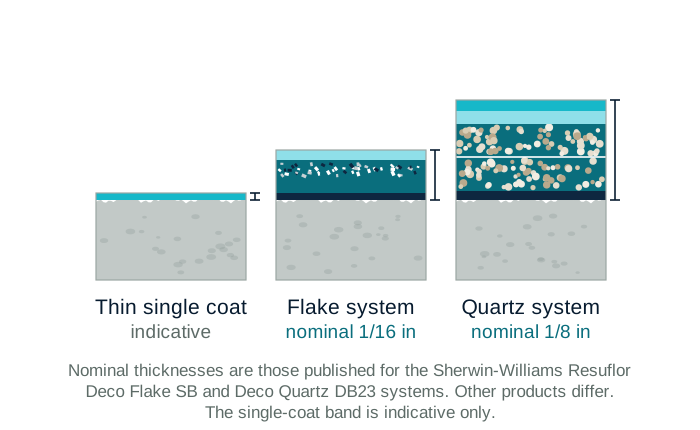
The word epoxy covers everything from a thin single-coat product to a multi-layer system, and the difference in material and labor is substantial.
Broadly, cost rises with the number of layers and the amount of material in them. A solid color system is usually the simplest build. A decorative flake system adds a broadcast and the coats needed to seal it. A quartz system commonly uses more than one broadcast pass and more aggregate. A metallic finish adds artistic labor and a sample approval process.
For a sense of scale, Sherwin-Williams publishes its Resuflor Deco Flake SB system at a nominal 1/16 inch and its Resuflor Deco Quartz DB23 system at a nominal 1/8 inch. Those figures describe those two named systems from that manufacturer. They are useful as an illustration of how much build depth can differ between system types, and they should not be applied to every flake or quartz floor on the market.
More layers also means more days, since each coat has to be applied within its own window. Chemistry choice interacts with all of this, and the comparison of epoxy and polyaspartic systems covers where the trade-offs fall.
The Decorative Finish
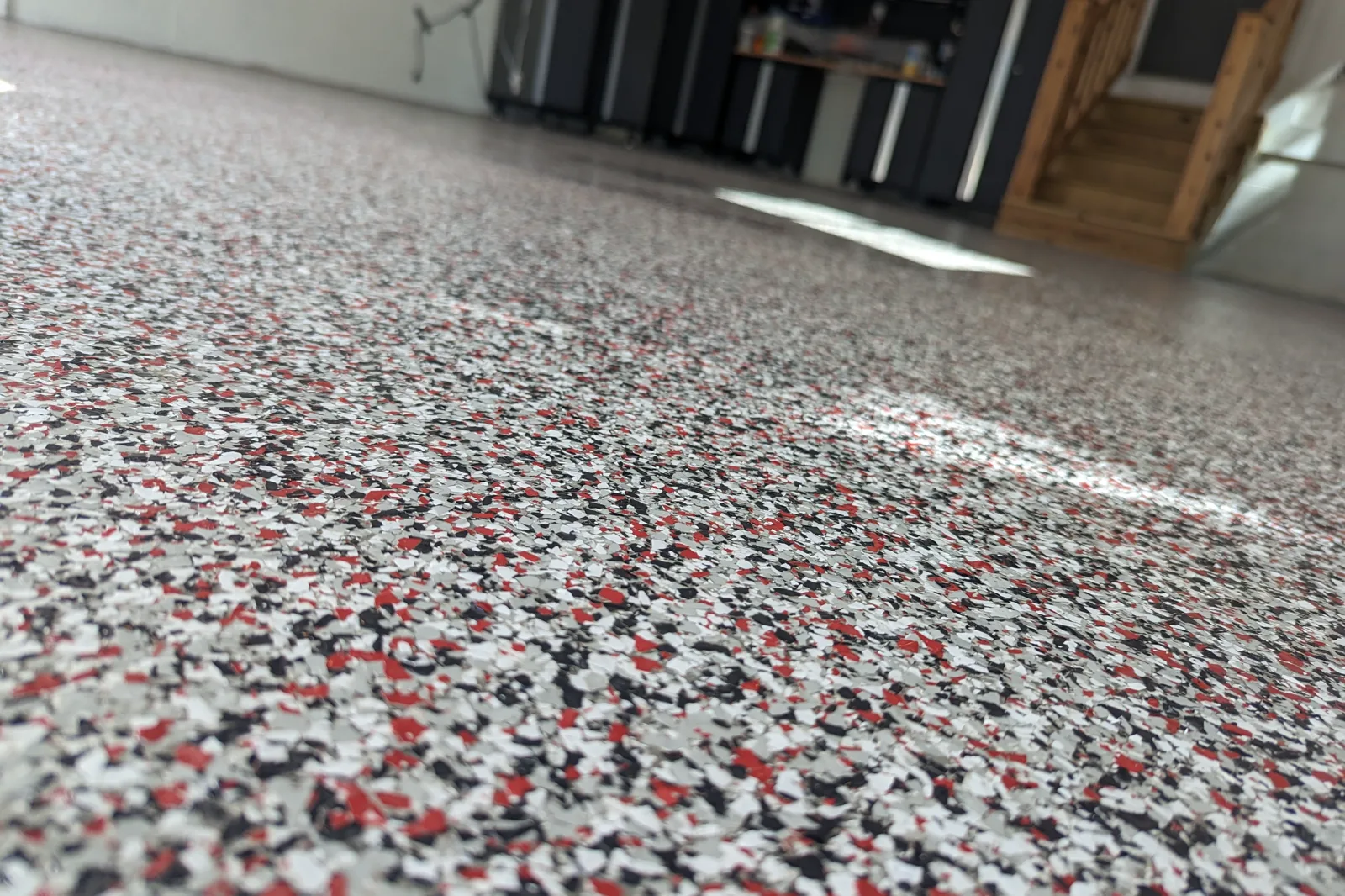
Appearance affects price in fairly predictable ways.
Stocked colors and standard flake or quartz blends are usually the most economical. Custom blends, multiple colors, borders, inlays, logos, and metallic effects add material cost, labor, or both. Coating a stem wall, a step, or an integral cove base adds surface area and a good deal of hand work relative to its size.
Slip-resistant texture is worth deciding deliberately rather than leaving to chance. More texture is not automatically better: an aggressive surface is harder to clean, while a smooth gloss can be slippery when wet.
Equipment, Access, and Job Complexity
Two jobs with the same floor area can differ in how difficult they are to carry out.
Access matters: stairs, narrow entrances, long carries from the driveway, and limited electrical supply all add time. A garage that is still full when the crew arrives adds time. Occupied buildings, restricted working hours, and work that has to be phased around a business or a household schedule add time as well, and where a space cannot be closed for a normal working period, the sequence may have to change to suit the downtime available rather than the other way around.
None of this is visible in a square footage figure, which is part of why an inspection matters.
What a Professional Quote Should Include
A quote that only states a total and a color is not enough to compare against anything. A useful proposal makes clear:
- The preparation method that will be used
- Whether removal of existing material is included or excluded
- Which repairs are included, and how additional ones would be priced
- Whether moisture will be evaluated, and what happens if results are high
- The product family and system being installed
- The number of coats and what each one is
- The decorative media, including whether the blend is stocked or custom
- The topcoat, its sheen, and any slip-resistant additive
- Surface texture and where it applies
- What areas are included: floor only, or steps, stem walls, and thresholds
- Return-to-service guidance for foot traffic, heavy items, and vehicles
- Cleanup and disposal
- Any warranty offered, with its terms stated rather than implied
- What conditions can trigger a change order
Why One Quote Is Much Lower Than Another
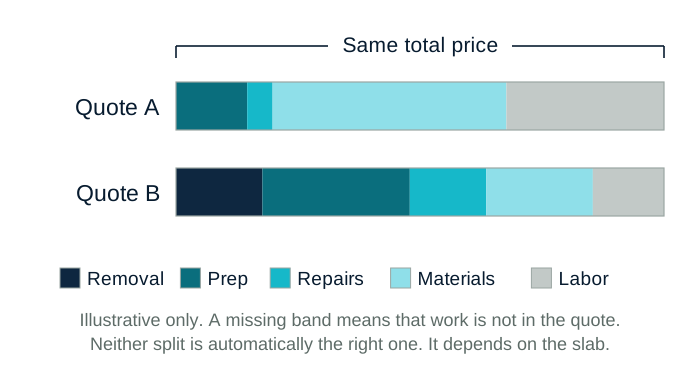
A lower price usually means a smaller scope, not a bargain and not a scam. The difference typically comes from some combination of:
- Washing or etching instead of mechanical preparation
- Removal excluded, or assumed not to be necessary
- Fewer repairs included
- A single coat rather than a multi-layer system
- A partial broadcast rather than a full one
- No separate topcoat
- Consumer-grade rather than professional-grade products
- Floor only, with steps and stem walls excluded
- Different levels of insurance, trained labor, and after-sales support
The important point is that this works in both directions. A smaller scope can be entirely appropriate for a sound, clean, bare slab in a garage used for storage. It is a poor fit for a slab with a failing coating and oil contamination. What you are trying to establish is not which quote is cheapest, but which scope matches your floor.
Professional Installation and Doing It Yourself
A do-it-yourself kit has a lower purchase price, and on a suitable slab with careful work it can produce a decent floor. The comparison is not as simple as the price on the box, though, because the kit is the material and not the project.
A realistic comparison includes:
- Renting a grinder, and the tooling that goes with it
- Dust extraction, which is not optional indoors
- A separate hand grinder for edges and corners
- Removing and disposing of anything already on the slab
- Crack and joint repair materials
- Degreasers or treatment for contamination
- Mixing tools, squeegees, rollers, spiked shoes, and protective equipment
- Enough help to place the material before its working time runs out
- The cost of putting it right if something goes wrong
That last item is the one that changes the arithmetic most. A coating that does not bond generally has to come off before the floor can be redone, and removal of a failed coating is harder than preparing bare concrete would have been.
None of this means a DIY floor always fails, and paying a professional does not guarantee a good result either. What professional pricing buys is the equipment, the experience to judge the slab, and someone who carries responsibility for the outcome.
The Same Garage, Before and After
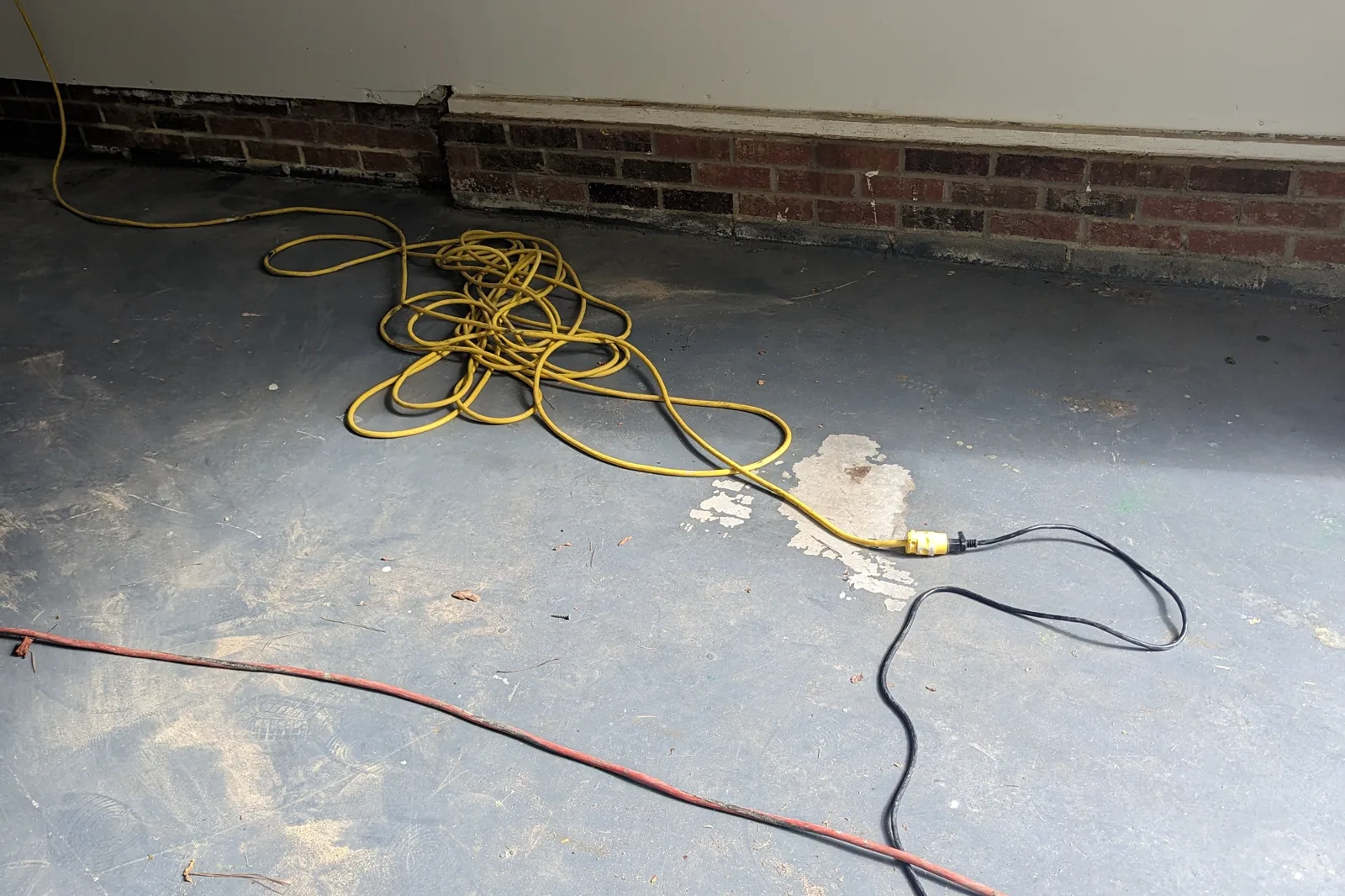
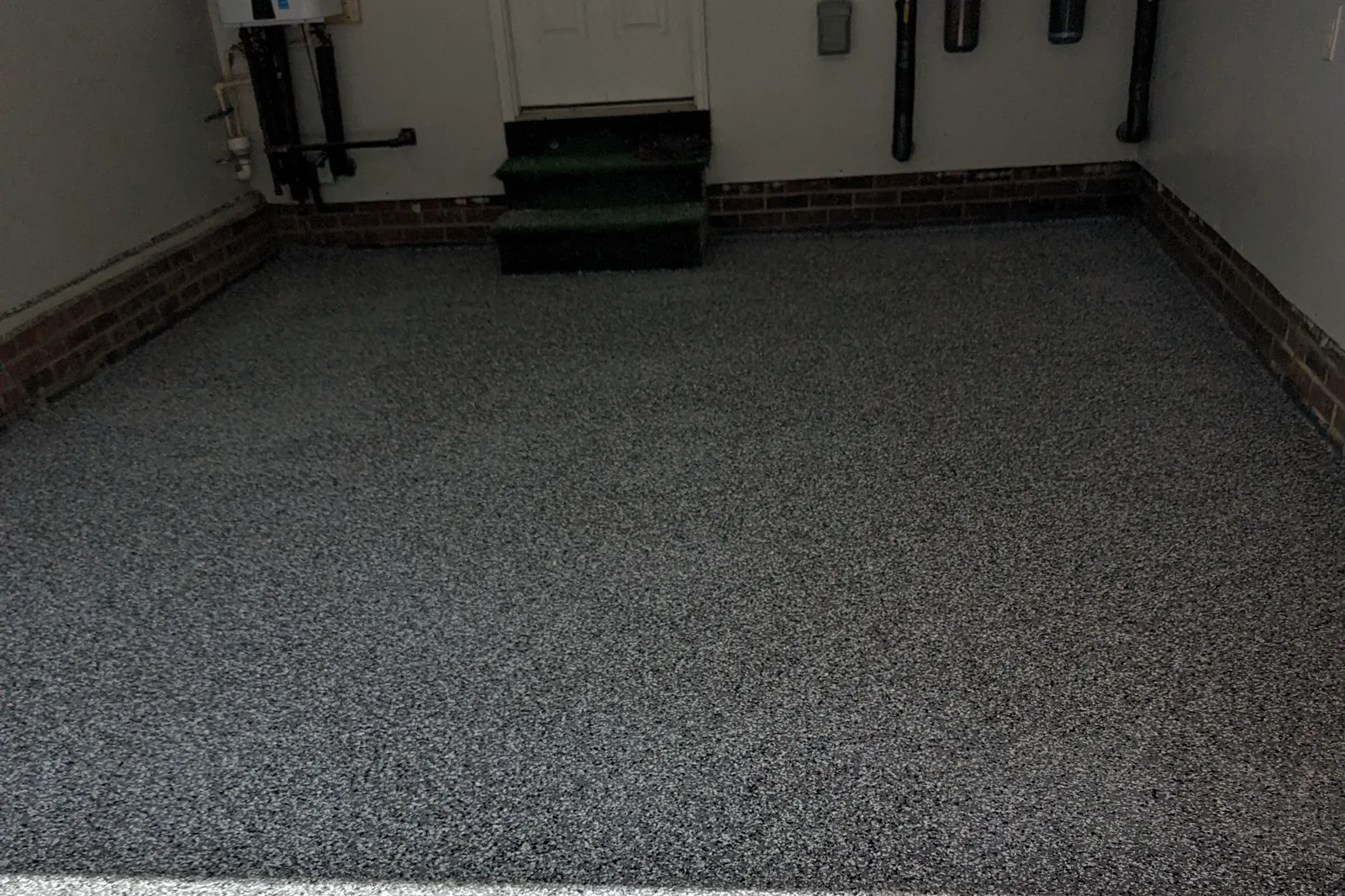
These two photographs are the same garage. Very little of the difference between them is the color.
The old coating had to be removed, the slab had to be ground and cleaned, the edges and the base of the knee wall had to be done by hand, and only then could the new system go down. That is where the days went, and where most of the price went with them.
This is also why a quote cannot sensibly be written from a photograph. What you can see in the first image tells an installer that there is removal work, but not how well the old coating is attached, which is what determines how long it takes to get off.
A Checklist for Comparing Quotes
Ask every contractor the same questions and write the answers side by side:
- What is the measured area, and what surfaces are included?
- How will the concrete be prepared, stated as a method rather than a description?
- Is removal of existing material included, and what if there is more than expected?
- Which repairs are included, and how are additional ones priced?
- Will moisture be evaluated, and what happens if the readings are high?
- What system is being installed, and how many coats?
- Is the decorative media stocked or custom, and is the broadcast partial or full?
- What topcoat, sheen, and slip resistance are included?
- When can the floor take foot traffic, heavy items, and vehicles?
- What is specifically excluded?
- What warranty is offered, and what does it not cover?
- What have you found on slabs like this one before?
Differences in the answers explain differences in the price far better than the totals do.
The Bottom Line
There is no honest single figure for a garage floor coating, because the price is set by the slab, the system, and the amount of work needed to get one ready for the other.
The most useful thing you can do is stop comparing totals and start comparing scopes. Once two quotes describe the same preparation, the same removal, the same repairs, and the same system, the prices become genuinely comparable, and usually much closer than they first appeared.
If you are still deciding what to have installed, the garage floor epoxy guide covers the options and the questions worth asking first.