
Polyaspartic and polyurethane get compared because they compete for the same position: the last coat, the one you walk on. That is the only layer of a floor system that has to face traffic, sunlight, mops, and spilled fuel, and it is the layer a buyer is most likely to be told a brand name for.
Both are families of chemistry rather than single products. Within each family, formulations differ in cure speed, ultraviolet performance, abrasion resistance, chemical resistance, and the conditions they can be applied in. Two polyurethanes can behave less like each other than one of them behaves like a polyaspartic.
So the question worth asking is not which chemistry wins. It is what the exposed finish coat has to do in your space, and which specific product is documented to do it.
What the Topcoat Is Actually Responsible For
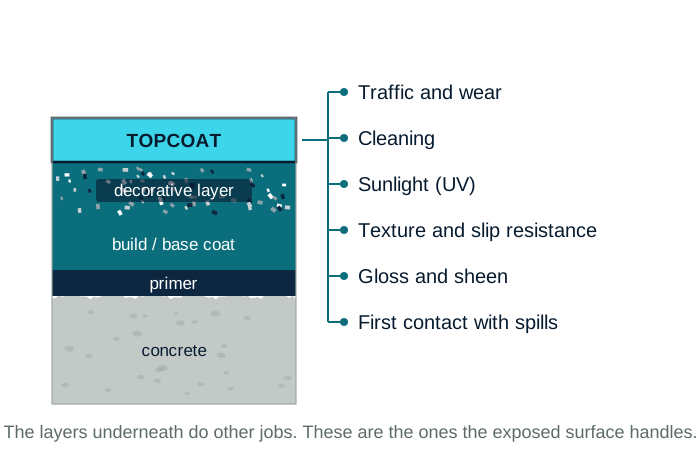
The layers underneath a floor system are chosen for adhesion, thickness, and appearance. None of them ever touches a shoe.
The finish coat handles a different list entirely. It takes the traffic and the wear. It meets every cleaning chemical and every spill first. It is the only layer sunlight reaches. It sets the gloss level, and it carries whatever slip-resistant texture the floor has.
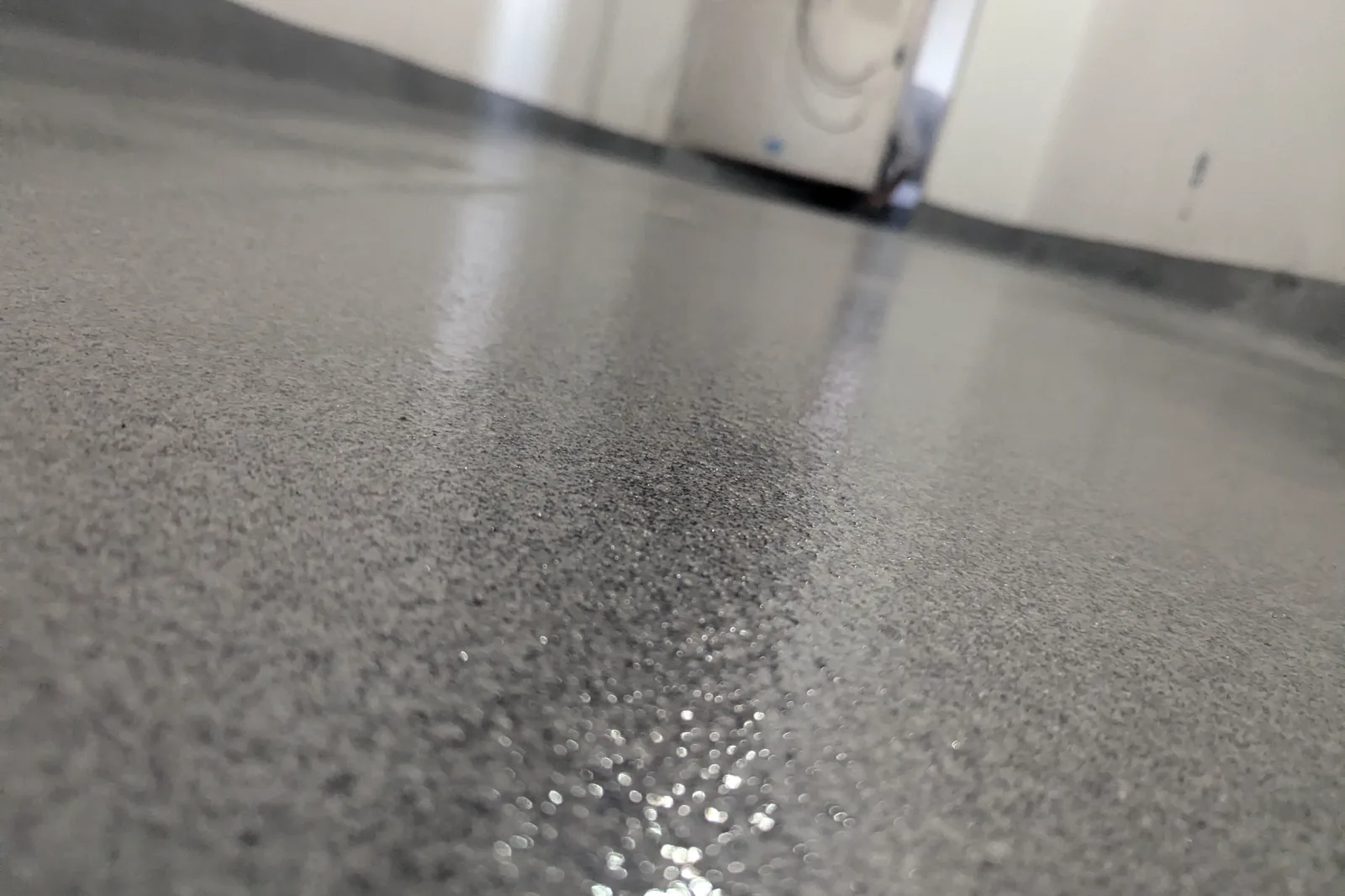
That list is why the finish coat is frequently a different material from the build coats beneath. It is also why comparing "epoxy versus polyaspartic" and "polyaspartic versus polyurethane" are different conversations: the first is largely about how a system is assembled, which is covered in the guide to epoxy and polyaspartic systems. This one is only about the layer on top.
Where Polyaspartic Coatings Tend to Be Used
Polyaspartic products are fast-curing resins, and that speed shapes where they get specified.
They appear most often where a space cannot stay closed for long, and where the finish will see daylight. Clear formulations work well over flake and quartz because they seal the media without clouding it, and many products in the family are formulated for exterior exposure. Where polyaspartic flooring systems sit inside a complete build, and what a quote naming one should still specify, is a separate question from the chemistry itself.
The speed cuts both ways. A short working time gives an installer less room to correct an uneven area, a missed spot, or a roller mark before the material sets, which makes crew coordination and experience part of the specification rather than a nice-to-have.
Where Polyurethane Coatings Tend to Be Used
Polyurethane, often called urethane in the trade, is a long-established finish over resinous floors and remains widely specified.
It is chosen for abrasion and impact resistance, for chemical resistance in the right formulations, and in situations where a longer application window makes for a better installation. Aliphatic polyurethanes are formulated to be light-stable and are routinely used as the exposed layer in daylit spaces.
Manufacturers still specify it in current systems. Sherwin-Williams describes its Resuflor Topcoat Metallic II system as finishing with a UV light-stable satin urethane topcoat, and its Resuflor Deco Flake SB system as a broadcast sealed with a clear polyurethane finish, offered in satin as standard with high-gloss options. Those are two named systems from one manufacturer rather than a statement about urethanes generally, but they make the point that urethane is a current choice for the exposed layer and not a legacy one.
The old shorthand that "polyurethane yellows" is not a safe generalization. Ultraviolet behavior depends on the formulation, and a product data sheet will tell you what a specific product is approved for. The chemistry name will not.
Comparing Them as Decision Factors
The table below describes tendencies. Note that two of the rows have the same answer in both columns, which is the honest result rather than an oversight.
| Decision factor | Polyaspartic | Polyurethane |
|---|---|---|
| Typical role | Clear or pigmented finish coat, sometimes the whole build | Finish coat over epoxy or other build layers |
| Working time | Generally shorter, with less room to correct | Often longer and more forgiving on site |
| Return to service | Frequently selected where speed matters | Varies by product; often a longer window |
| UV stability | Commonly formulated for exterior exposure | Light-stable in aliphatic formulations; varies by product |
| Abrasion and wear | Published results vary widely within the family | Published results vary widely within the family |
| Chemical resistance | Chemical-specific; read the resistance chart | Chemical-specific; read the resistance chart |
| Application conditions | Cure behavior shifts with temperature and humidity | Approved ranges vary by product |
| Appearance | Gloss, satin, and textured options | Gloss, satin, and textured options |
Working Time and Return to Service
These are two different clocks and they matter to two different people.
Working time is the installer's problem: how long the crew has to spread and level the material after mixing. Return to service is yours: how long before the space can be used again.
Fast-curing products tend to compress both. That is convenient for you and demanding for the crew, and it is one reason a fast system installed by an inexperienced team can produce a worse floor than a slower system installed carefully.
There is no universal schedule for either family. Recoat windows, foot-traffic times, vehicle times, and full cure all depend on the exact products, the build, and the conditions on the day. Some systems return to service faster than others, but the written schedule for the products actually installed is the one that matters. What that schedule should contain is covered in the return-to-service guide.
Ultraviolet Exposure
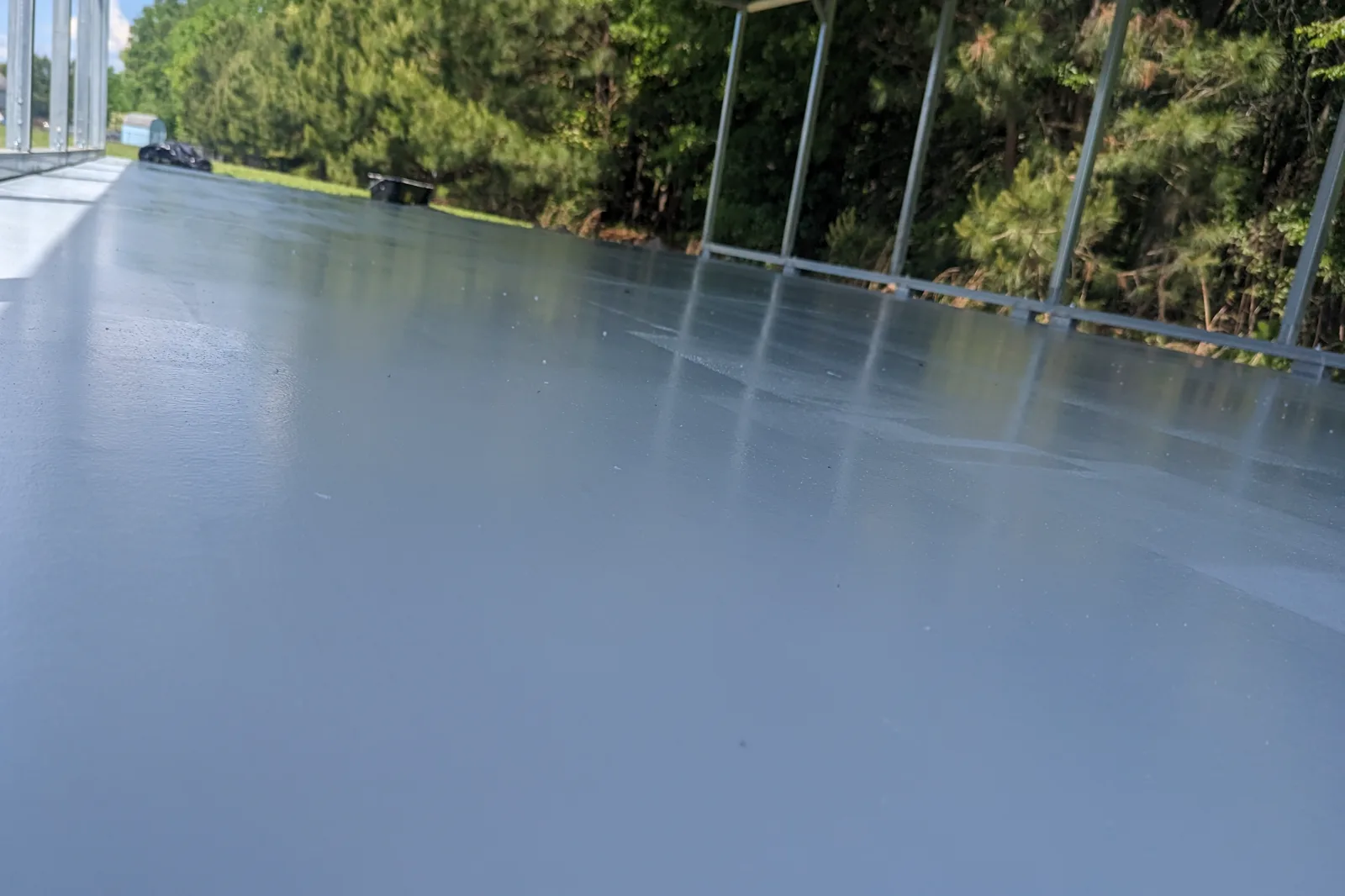
Sunlight reaches the finish coat and stops there, so ultraviolet stability is a topcoat question rather than a whole-floor one.
Both families include products formulated for exterior exposure, and both include products that are not. Aliphatic polyurethanes can be light-stable. Many polyaspartics are chosen specifically for UV performance. Neither statement transfers to every product carrying that name.
Manufacturers are usually explicit where limits exist. The Sherwin-Williams color card for its Resuflor Topcoat Metallic range, for instance, footnotes that certain colors will amber over time because of the inherent characteristics of the resin technology. That note applies to specific colors in that range, and it is exactly the kind of product-level statement worth looking for rather than assuming.
If daylight reaches your floor, the useful question is short: is this specific product approved for this exposure, and what does the manufacturer say about color stability?
Abrasion, Scratches, and Wear
Four things get muddled together here, and separating them makes the conversation far more useful.
- Hardness is resistance to indentation. A harder film is not automatically a longer-lasting one.
- Abrasion resistance is resistance to material being worn away, and it is measured by standard test methods that produce comparable numbers.
- Scratch visibility is how obvious a mark is once it exists. A high-gloss surface shows fine scratching that the same product in satin would hide.
- Flexibility is the ability to move without cracking, which sometimes trades against hardness.
A product can rank well on one and poorly on another, so a single claim that one chemistry is "tougher" does not survive contact with the detail.
If wear resistance genuinely matters for your space, ask for the manufacturer's published abrasion result for the specific system and the test method it was measured by. Comparable figures measured the same way are worth something. A one-word claim is not. No resinous floor is scratch-proof in any case, and grit tracked in on tires does more damage than most people expect.
Chemical Exposure
Chemical resistance is the area where blanket claims fail most completely, because resistance is specific to both the formulation and the chemical.
A product that handles motor oil well may respond differently to brake fluid, a strong solvent, a particular acid, or a hot cleaning chemical. Concentration matters, and so does how long a spill sits before it is cleaned up.
For anything beyond ordinary household exposure, selection should be made against the manufacturer's chemical resistance data for the actual substances involved, not against a general reputation. Facilities with genuine chemical exposure should be specifying from that data with the exposures written down.
Flexibility and Slab Movement
Concrete moves. It expands and contracts with temperature, and slabs can move at joints and cracks for structural reasons that have nothing to do with the coating.
More flexible does not automatically mean more durable. A flexible finish may tolerate small thermal movement better while giving up hardness that a busy floor needs. The right balance depends on the space rather than on a preference.
What no topcoat can do is stop a slab from moving. Where movement exists, it is managed by how joints and cracks are treated during installation, not by the choice of finish coat. That is a separate decision, covered in the installation process guide, and where movement telegraphs through a finished floor the cause usually sits below the coating rather than in it, as explained in the guide to why coatings come loose.
Application Conditions
Every coating has a range of temperature, surface temperature, and humidity it is approved to be applied in, and those ranges differ between products in both families.
This matters to you for two reasons. Conditions outside the approved range are an installation risk regardless of how good the product is. And the width of the application window affects how much can go wrong on the day: a short pot life in a warm space leaves very little margin.
It is reasonable to ask what conditions the chosen product requires and what the crew does if the weather does not cooperate. A contractor who reschedules rather than pushing on is applying the product correctly.
Gloss, Sheen, and Texture
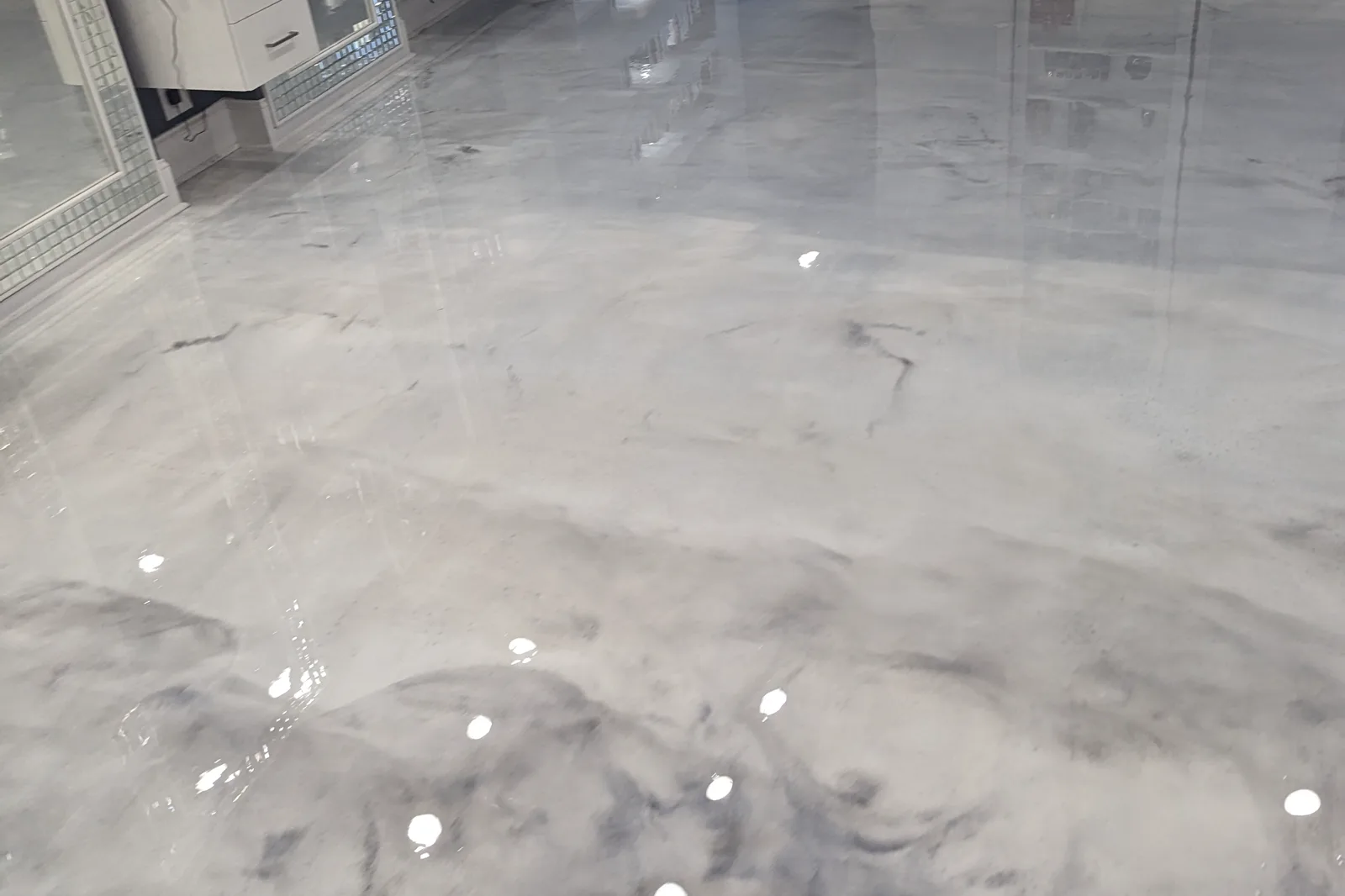
The finish coat sets what the floor looks like at the surface, and both families offer gloss and satin options.
Sheen is worth deciding deliberately. High gloss looks dramatic and reflects light well, and it also shows fine scratching, dust, and footprints more readily. Satin hides wear better and photographs less impressively. Neither is the correct answer in the abstract.
Slip-resistant additives live in this layer too, and they interact with sheen and cleaning. More texture gives more traction and is harder to mop; a smooth gloss is easier to clean and can be slick when wet. Ask what texture is being specified, where it applies, and how the manufacturer says the finished surface should be cleaned.
Garages
For a garage, the finish coat usually has to deal with daylight through an open door, tires arriving warm from the road, dropped tools, road salt and grit, and occasional fuel or oil.
Both families include products suited to that. What separates a good specification from a poor one is whether the chosen product is documented for those exposures, and whether the schedule for getting the garage back suits you. A faster system is genuinely valuable if you need the space, and irrelevant if you do not.
Commercial and Industrial Spaces
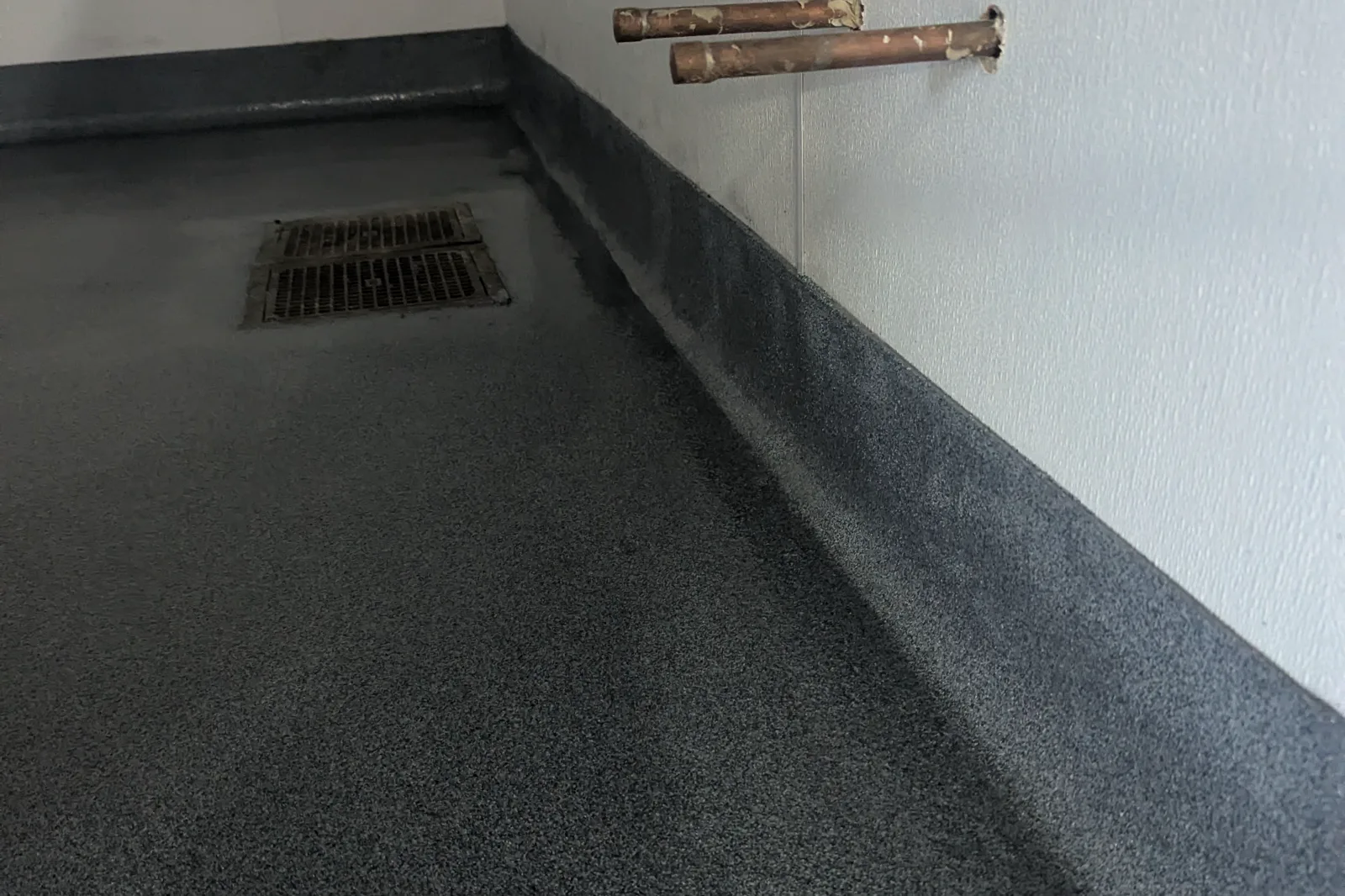
Here the environment should drive the decision, and the environments differ enormously.
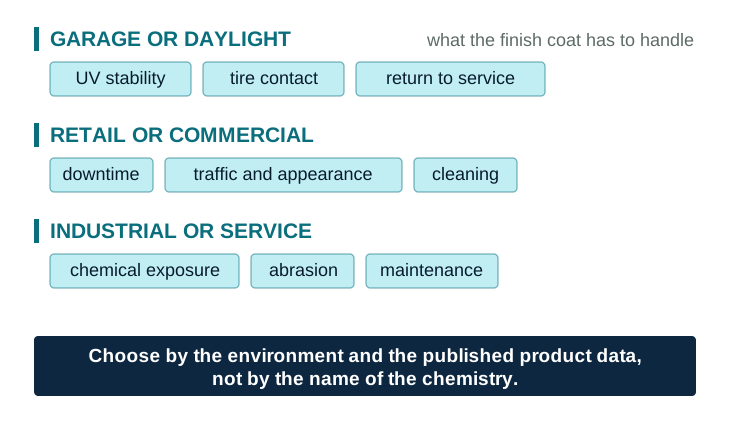
A retail floor is usually about downtime, appearance, and routine cleaning. A vehicle service area is about oils, fluids, abrasion, and how aggressively it will be cleaned. A wash-down area adds standing water and sanitising chemicals. Those are different specifications, and they can point to different products within either family.
What This Does to Cost
There are no fixed figures worth publishing here, because the finish coat is one line in a larger project.
Product price differs between and within both families. Beyond that, the finish affects cost through the number of coats a system needs, how fast the crew has to work and therefore how many people are needed, whether the schedule has to accommodate a longer cure, what surface preparation the system requires beneath it, and what maintenance the manufacturer expects afterwards.
A faster return to service can also be worth real money in a commercial space, which does not show up in a material price at all. The detail on what drives coating cost covers how these combine.
Questions to Ask a Contractor
These move the conversation from chemistry names to documented performance:
- What exact topcoat product are you using?
- Is it a polyaspartic, a polyurethane, or another chemistry?
- Why is that product appropriate for this space and this exposure?
- What does the manufacturer say about ultraviolet exposure and color stability?
- What published abrasion result is available, and by which test method?
- What chemicals is it rated for, and can I see the resistance data?
- What is the written return-to-service schedule for the system being installed?
- What temperature and humidity limits apply during installation?
- What texture or slip-resistant additive is included, and where?
- What cleaning and maintenance does the manufacturer recommend?
A contractor who can answer these is specifying a product. One who can only name a chemistry is describing a category.
The Bottom Line
Polyaspartic and polyurethane are both credible choices for the exposed layer of a floor, and both families contain products that would be wrong for your space.
Polyaspartic is frequently selected where a fast return to service matters and where daylight reaches the floor. Polyurethane is frequently selected where a longer application window helps, and where a particular abrasion or chemical requirement drives the specification. Plenty of good floors use either.
The decision that actually protects you is not picking a chemistry. It is getting the specific product named, checking that it is documented for the exposure your floor will see, and getting the schedule and maintenance instructions in writing.