
A floor coating is only as secure as whatever it is stuck to. On most projects that is the top few millimetres of a concrete slab, which is rarely in the condition a coating needs. It may be sealed or closed by troweling, carry curing compound or old coatings, or hold dust and residue from years of use.
Diamond grinding is the mechanical step many professional installers use to deal with that surface before epoxy or another resinous coating goes down. This guide explains what it does, what it does not do, and what to look for in the video below.
The footage shows a walk-behind grinder passing across a large warehouse-style slab with a vacuum hose attached, while the crew works across the floor. Visible dust in the air is a reminder that grinding is dusty work even when extraction is in use.
What Is Diamond Grinding?
Diamond grinding runs rotating heads fitted with industrial diamond tooling across a concrete floor. The tooling mechanically abrades the surface, wearing it away in a controlled way.
In practice that does a few useful things:
- It removes weak or loose surface material, such as laitance, a thin and often powdery top layer.
- It can remove some surface contaminants, sealers and thin coatings, depending on what they are and how well they are bonded.
- It exposes sound concrete underneath.
- It leaves a surface texture, often called the profile, that gives a properly selected coating something to grip.
The tooling is changed to suit the slab and the job. Coarser tooling cuts faster and leaves a rougher texture, while finer tooling refines the surface. For a deeper look at the machines and tooling, see our page on concrete grinding.
Why Surface Preparation Matters
A coating system ultimately depends on its bond to the concrete substrate. Every layer above it, however good, relies on that bond holding.
When the surface is not prepared properly, the usual consequences are:
- Poor adhesion, where the coating never fully bonds to the slab.
- Peeling, often starting at edges, joints or wheel paths.
- Delamination, where a layer lifts away from the one below it, sometimes in sheets.
- Premature failure, where a floor that should have lasted years needs repair or replacement early.
Grinding alone does not guarantee a successful floor. Moisture moving through the slab, the condition of the concrete, repairs, product selection, correct mixing, installation conditions and curing all affect performance. Grinding addresses one important variable. It does not replace the others. Our guide to why epoxy floors peel covers how those causes combine.
Grinding vs. Acid Etching
Acid etching is the other surface treatment people most often ask about. It is a chemical method rather than a mechanical one, and it is not the same job.
- Diamond grinding physically removes surface material. The crew can see and control how much is taken off, and the same machine can remove many coatings and residues.
- Acid etching applies an acid solution that reacts with the cement at the surface. It depends on the solution reaching bare, absorbent concrete, and it needs rinsing and neutralising afterwards.
Etching has real limits. It does not remove sealers or most old coatings, and it does not lift oil that has soaked in. Results can be uneven where the concrete is dense or the solution has not reached it equally. That does not mean it never has a place. Some product data sheets allow it for certain systems and conditions.
This is why installers commonly prefer controlled mechanical preparation when the coating system and the slab call for it: it is easier to verify, and it works on a wider range of surfaces. The product's own data sheet and the condition of the slab decide what is actually appropriate.
Dust Control
Look at the grinder in the video and you will see a hose running from the machine to a vacuum or dust-collection unit. Professional grinding is commonly paired with dust collection so that much of the dust the machine creates is captured at the source instead of being left to spread through the building.
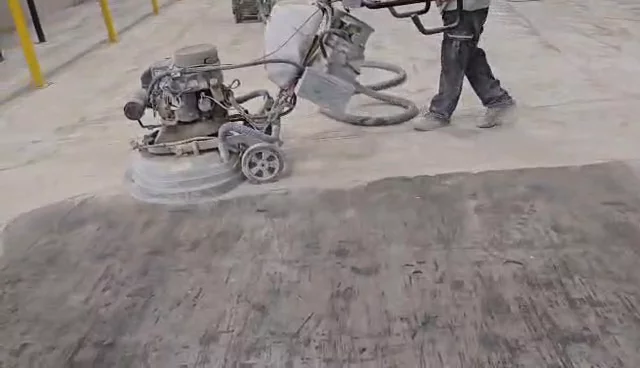
Extraction is not a promise of a dust-free job. Some dust escapes, especially at edges and where the shroud meets an uneven floor, and fine concrete dust can contain respirable crystalline silica. That is why dust control, protection of nearby areas and clean-up are worth discussing before any grinding starts, particularly in a building that stays occupied.
What Happens After Grinding?
Every installation is different, and the product manufacturer's instructions govern the details. In general terms the workflow runs like this:
- The prepared concrete is inspected. Grinding often shows cracks, soft areas and old repairs that were hidden before.
- Cracks, joints and damaged areas are addressed as the project requires.
- Remaining dust and debris are removed so the coating is not laid over loose material.
- Conditions relevant to the system are evaluated, such as moisture in the slab.
- The selected primer, base coat or coating system is applied according to its requirements.
- The remaining layers of the floor system are built up.
The exact preparation and installation requirements vary with the substrate and the coating manufacturer. The installation process guide walks through how the layers of a full system are built.
Garage Floors and Commercial Floors
Preparation matters on every slab, whether it is a residential garage, a warehouse, a shop or a busy work area.
On a garage floor, the questions are often about old sealers, oil stains and the edges where a walk-behind machine cannot reach. A decorative flake or metallic finish makes the surface far more visible, but the bond underneath still decides how long it lasts.
On commercial and industrial floors, the same step runs at a larger scale. The floor in our video is a good example: a large open slab, a walk-behind grinder working in overlapping passes, and a crew managing dust across a wide area. Forklift traffic, wheel loads, heavy equipment and chemicals put more stress on the bond, and large floors can have more joints, more repairs and a bigger area to prepare.
Frequently Asked Questions
Do you have to grind concrete before epoxy?
Not every product has the same requirement, but many professional epoxy and resinous systems call for mechanical preparation, and grinding is a common way to provide it. The manufacturer's data sheet states what surface its product needs.
Can you put epoxy over smooth concrete?
Smooth, sealed or power-troweled concrete usually offers little for a coating to grip. Putting epoxy over it without preparation increases the risk of poor adhesion. The surface generally needs to be opened up first, by grinding or another mechanical method suited to the system.
Does concrete grinding remove old coatings?
It can remove many thin coatings, sealers and paints. Thick, heavily bonded or elastic coatings and adhesives can be harder, and may be removed by other methods first. Older adhesives and floor coverings should be identified before grinding, because some have contained asbestos.
Is concrete grinding dusty?
Yes, it creates fine dust. Dust collection captures much of it, but it does not remove all of it, so protection of the area and clean-up still matter.
Can grinding fix cracks in concrete?
No. Grinding does not repair cracks. It often reveals them, and they then need to be assessed and repaired using methods suited to the crack and the coating system. Structural movement or moisture problems need to be understood, not ground over.
How long does concrete grinding take?
It depends on the size of the floor, the condition of the concrete, what is on it and how much has to come off, along with edges, access and the equipment used. A contractor who has seen the floor can give a realistic estimate. A generic figure would not be reliable.