
Concrete grinding
The mechanical process polishing starts from, and how it works when the goal is preparation instead.
Visit pageCommercial and industrial floor coating guidance, with residential garage flooring resources
Finished concrete
Polished concrete is not a coating. It is the slab itself, ground through progressively finer abrasives and hardened until the surface reads as a finished floor. That makes the concrete underneath the whole story, and it is why the result is shaped as much by the slab as by the contractor.
Epoxy Pro Leads does not carry out this work. We explain how it is done and what to ask, then connect owners and facility teams with contractors who do it.
The finish comes from the existing concrete, so no two slabs end up looking the same.
Polishing is a sequence of steps, and how far it goes sets the sheen.
It sits alongside coatings as an option, and neither is better in every space.
The floor
A polished concrete floor is produced by grinding a slab with diamond abrasives in a series of steps, treating it with a densifier, and refining it until it reaches the sheen that was specified. The result is concrete finished as concrete, not covered with a film.
Because nothing is applied over the top as a thick layer, the character of the floor comes from the slab: its colour, its aggregate, its joints and its history. Some of that is an attraction and some of it is a limit, and a good contractor will tell you which is which before you commit.
Grinding and polishing
Grinding for a coating ends once the surface is open enough to bond to, and the floor is then covered. Polishing carries on from grinding through finer and finer tooling, so the concrete itself becomes the finished surface.
The process
Polishing works by refining the surface in stages. Each pass removes the scratches left by the one before it, using a finer abrasive each time, in the same way a piece of wood is sanded through coarse to fine paper. Skipping steps leaves scratches the next stage cannot fully remove.
The exact sequence differs between contractors and between slabs. As a general pattern, it looks like this.
Hardening
Densifiers are liquid treatments, commonly based on silicates, that soak into the concrete and react within it. The intended effect is a harder, denser surface that wears more evenly and creates less dust.
They are an important part of the process, but they are a part. A densifier cannot make a weak slab strong, and it does not by itself produce the finish. Ask which product is being used, when in the sequence it goes on, and what the supplier says about it.
Appearance
Two separate choices describe how a polished floor looks. The first is how much of the concrete is cut away, which decides how much of the sand and stone shows through. The second is how fine the final polishing goes, which decides how much light the surface reflects.
Terms for both vary between contractors and published guidance, so a name alone is not enough. Ask for the finish to be defined in writing and shown on a sample, ideally on your own slab, before the whole floor is committed.
The limit
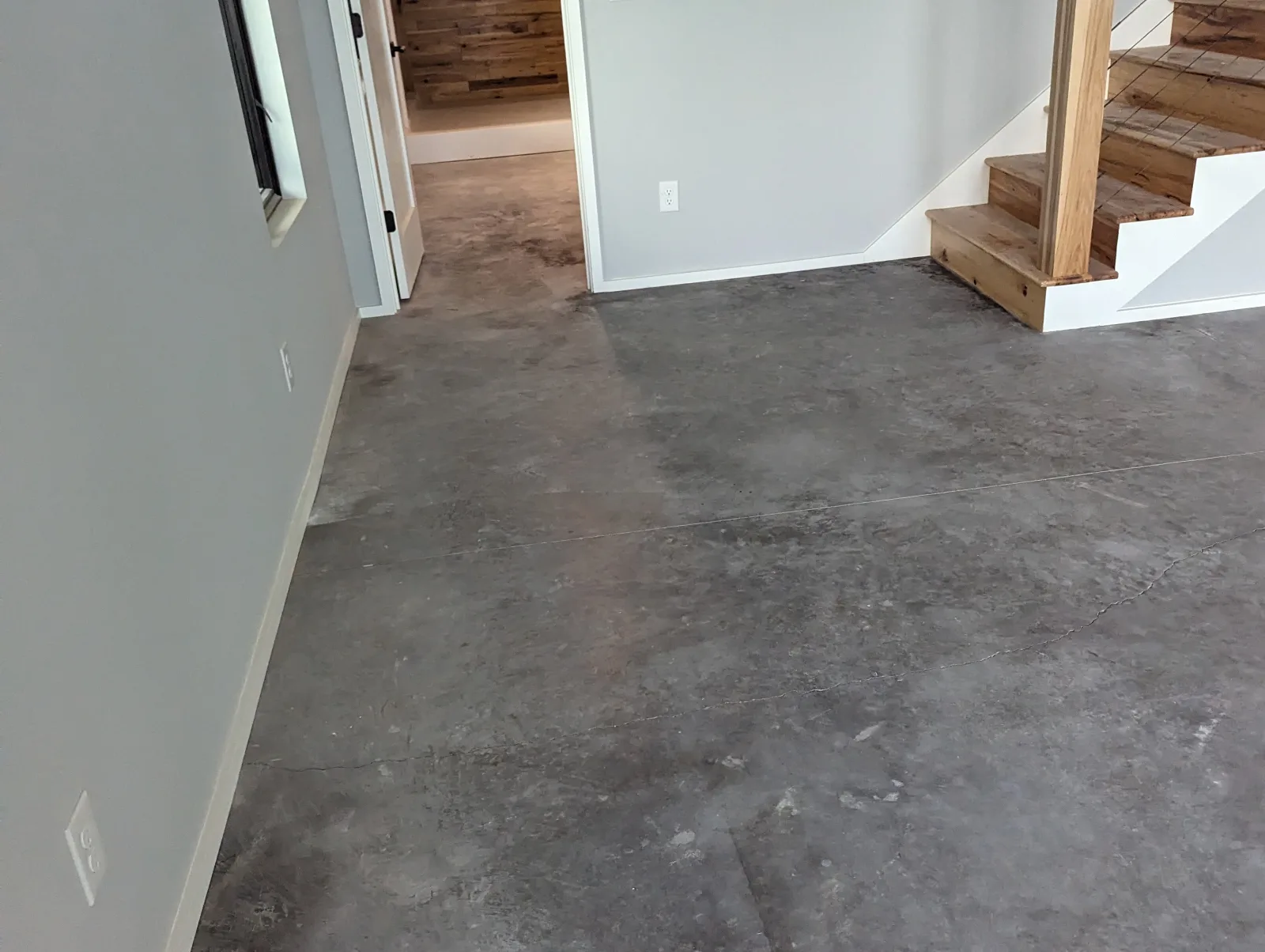
The slab sets the ceiling on the finish. Concrete that was poured and finished to be covered is often not suited to being the final surface, and what lies in it cannot be added later.
A slab can vary across a floor and between pours. Different mixes, finishing methods, earlier repairs and patches, stains, and the depth of aggregate near the surface all show up in the polished floor.
Expectations
A polished floor shows its concrete. Fine cracks, saw-cut and control joints, trowel marks, and changes in tone from one area to another are normal features rather than defects, and polishing generally highlights them rather than hides them.
Some of this can be improved. Cracks and joints are often filled, and repairs can be blended. Filled areas may still look different, and edges polished by hand rarely match the open floor exactly.
Applications
Polished concrete is chosen where the slab can carry the finish and the use suits it.
Residential use is typically indoors: basements, ground-floor slabs and open-plan living areas, particularly in new construction where the slab can be planned as the finished floor.
Garages are less straightforward, because hot tyres, salt and chemicals meet a surface that is not a sealed film. If a garage is the project, compare it with the coating options before deciding.
Comparison
Neither is better in every space. They are different kinds of floor, and the question is which set of trade-offs suits the building.
Upkeep
A polished floor is generally straightforward to keep clean, but it is not maintenance-free, and the right routine depends on the finish and the way the space is used.
Before the work
Whether a slab is a good candidate is a judgement that should be made on site.
Checklist
Polished concrete proposals can look alike on paper while describing very different finishes.
Next step
Epoxy Pro Leads is an independent education and contractor-introduction resource. We are not the installer, we do not employ crews, and we do not price, specify or inspect your floor.
When you send a request we read the details, and where it is a fit we pass it to one contractor who works in your area and takes on that kind of project. Submitting a request does not commit you to anything.
Related pages
The mechanical process polishing starts from, and how it works when the goal is preparation instead.
Visit pageHow coatings are chosen for working buildings, for comparison with a polished floor.
Visit pageA decorative coating for spaces where the look of the floor is the point.
Visit pageNext step
Share the project type, concrete condition, space use, and timeline so Epoxy Pro Leads can help route the request toward a qualified contractor conversation.
Submitting a request does not obligate you to hire a contractor.